Dependent on sourcing raw materials from China
Commodity prices have exploded as a result of extreme demand, among other things, and supply bottlenecks are causing serious problems for companies – the commodity crisis is keeping the world on tenterhooks and will probably continue to do so. Companies and suppliers in the foundry industry must prepare themselves as best they can. The all-clear, a light at the end of the tunnel, is not in sight for the time being.
By Thomas Pfeiffer, Düsseldorf
The be-all and end-all: a global network The Hüttenes-Albertus Group (HA) is represented in over 30 countries worldwide. A broad portfolio of chemical raw materials, minerals and sands must be managed – from small specialties to large-volume commodities. In order to organize purchasing for all HA companies and make it crisis-proof, the strategic and operational levels work closely together, but separately: strategically
, HA’s purchasing department operates centrally, while operational activities take place locally and close to the customer at the global production sites. The purchasing network of HA companies worldwide communicates regularly via digital media so that product market information can be exchanged transparently on an international level. With knowledge of the processes and changes in the different countries, the HA companies worldwide are able to react quickly even in times of bottlenecks and help each other immediately if necessary. This close networking makes it possible to remain able to deliver.
The challenges in the years 2020 to 2022
As in 2020, this year is also largely characterized by the effects of the coronavirus crisis. They are putting a strain on the global economy and companies are facing immense challenges. At the beginning of the pandemic, HA’s Purchasing department initially focused on assessing its own suppliers’ ability to deliver and their financial stability. The aim was to adapt to the drastic drop in demand from end customers. In the
3rd In the third quarter of 2021, an unprecedented combination of events occurred, which further exacerbated the already tense situation and continues to do so:
- Highly volatile demand makes planning more difficult.
- There is a shortage of staff at suppliers and logistics partners.
- Special events such as the UK’s withdrawal from the EU or the blockade of the Suez Canal further exacerbate the
situation - The force majeure reports are increasing.
Companies face one or more challenges of this kind from time to time, but never before have all of these events and effects occurred simultaneously worldwide. Such a “perfect storm” is unique to date.
A strategy for the storm
When dealing with so many simultaneous effects and obstacles, the cohesion and commitment of all employees is more important than ever. HAEinkauf works in a close network, worldwide and along the entire process chain – this enables the company to continue to deliver reliably.
No all-clear for 2022
The effects of the chip shortage are continuing, changes in energy costs need to be assessed and the consistent measures in China to reduce energy consumption and emissions are becoming increasingly visible. In order to remain fit for the future, companies must strategically prepare for the challenges and developments ahead
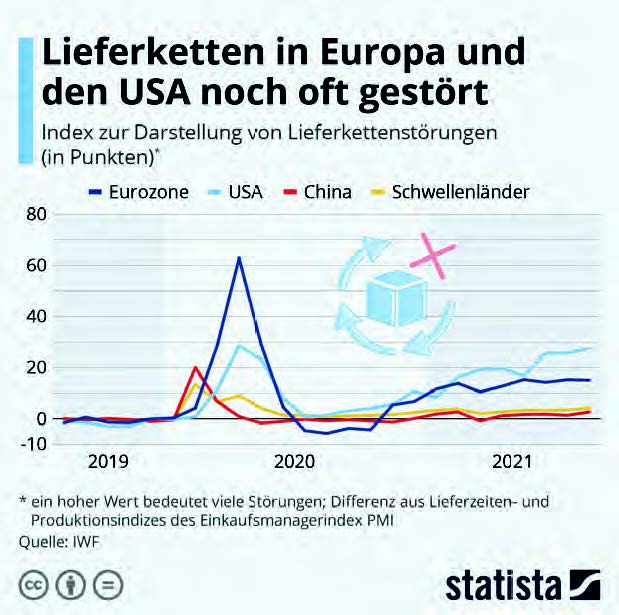
Supply chain disruptions are still ongoing. (Graphic: Statista)
The topics of the future
However, the raw materials situation in China is not the only uncertainty factor for today and tomorrow. The HA Group wants to be a reliable partner for its customers in the long term with its local and regional structures. In addition to the standard tasks of purchasing, the core issues of the future are:
> Resilience
> Sustainability
> Digitization/processes
We have defined each of these three topics in more detail for our teams and derived pragmatic principles of action from them that serve as a guideline for us.
1. For us, resilience means:
a. The consistent introduction of a supply chain or product strategy, combined with suppliers from different regions. If this is not possible, we agree clear, long-term supply contracts.
b. We think in several directions and look for alternative products and suppliers if necessary.
c. We pay attention to optimally coordinated demand planning, in good time and in advance.
2. sustainability plays an important role at HA, along the entire process chain:
a. We expect a clear commitment from our suppliers. They must sign and comply with our Supplier Code of Conduct or provide us with their own equivalent code.
b. We take into account the carbon footprint of the raw materials we purchase. It is a criterion when deciding for or against a supplier or a product.
c. The topic of sustainability is firmly anchored in our strategy and in all our order conditions – worldwide.
d. We are networked across the entire HA Group through an internationally recognized system. Our standards and principles apply worldwide.
3. digitalization/processes – this refers to automation, data management and new systems as well as cross-functional cooperation. In concrete terms, this means:
a. HA has a standard procurement process that is automated as far as possible and makes optimum use of the possibilities offered by ERP (Enterprise Resource Planning) software.
b. We use automated systems and information programs wherever possible so that our purchasing teams can concentrate on their core tasks.
c. Data analysis: Information and data from all over the world help us to derive the right measures.
d. Last but not least, AI tools and automated programs play an important role in identifying the optimal suppliers, possible alternative products and faster processes for HA
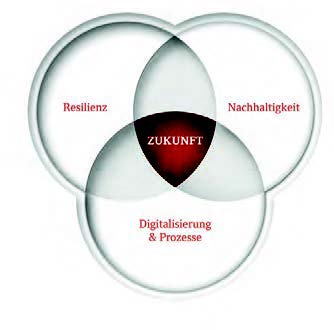
The core topics of the future for purchasing at HA. (Graphic: HA Group)
The role of China
The Chinese procurement market is an indispensable core element of the procurement markets of all industries – whether as a direct supplier or as a supplier to its own suppliers. In order to plan better and be prepared for anything, HA incorporates the Chinese government’s plans into its own strategies. The motto is: “hope for the best and plan for the worst”.
HA’s strategy is to have supply chains from at least two continents. However, this alone will not be enough in view of the current and upcoming situation. At the same time, close communication with customers is always important in order to have alternative solutions tested as a precaution.
Transparent communication also plays a key role, especially in times when face-to-face meetings are not possible. HA’s Purchasing department regularly communicates digitally and directly with its own suppliers – in China and worldwide. Intercultural communication and an understanding of the situation of the various stakeholders is therefore one of the core skills of a good buyer.
We are all facing major tasks and difficult times that represent a real test. Only those who take on the challenges with determination and constantly adapt their own strategy flexibly to the current circumstances will emerge from the crisis stronger and, above all, be and remain a reliable partner for customers.
www.ha-group.com
Thomas Pfeiffer, Member of the Executive Board, Vice President Global Sourcing HA Group