Vesuvius, a global leader in melt casting technology, is celebrating its 100th anniversary this year. From its origins in Pittsburgh during World War I to today’s new generation of solutions, the company has continued to evolve for its customers by anticipating the development of breakthrough technologies and processes.
Many of Vesuvius’ solutions have changed the steel and foundry industry. The company’s silica crucible is the only crucible capable of producing polycrystalline silicon used for solar cells, while Viso was the first isostatically pressed product to enable continuous casting in the steel sector. Since the company’s beginnings in 1916 with the goal of producing the most effective clay graphite crucible for melting steel, Vesuvius has pioneered development to meet the needs of its customers. Founded in Pittsburgh by the Arensburg brothers and their friend Arthur Jackman, the company was able to respond to the huge increase in demand for steel products caused by arms production for the First World War. From 1919, the company continued to develop the stopper, among other things, and continued to innovate throughout the 20th century.
The company history of Foseco, the foundry division of the Vesuvius Group, is also characterized by innovation. In 1932, Eric Weiss and Dr. Kossy Strauss founded Foundry Services Ltd in Birmingham, UK, which would eventually become Foseco. Dr. Kossy Strauss, a chemist, and Eric Weiss, responsible for the commercial sector, set themselves the goal of providing the foundry industry with products and services that would fundamentally improve their production. They began with six Flux products, which they continued to refine as they became more familiar with their customers’ needs and requirements. In the 1940s, Foseco developed the Feedex powder and Ferrux covering powders as well as innovations such as FEEDEX and KALMINEX exothermic feeders and Sedex, STELEX and sivex filters. Alcohol and water-based coatings, the development of the FDU (Foundry Degassing Unit) degassing technology and the INITEK process for the production of castings from nodular or vermicular graphite cast iron are also included.
Foseco Germany was founded in 1952 and has been dedicated to the requirements of the German foundry industry for 64 years.
Today, Vesuvius remains at the forefront of innovation for the steel and foundry industry with its 17 research centers, including the new global foundry research and development center in Enschede. The company has also established a new technical department dedicated to integrating continuous data collection into its solutions.
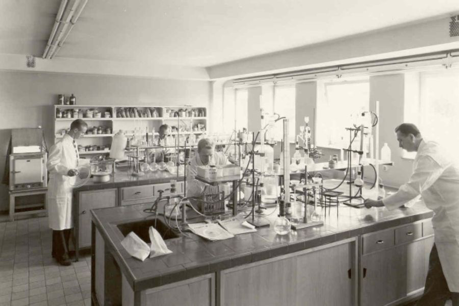
Photo from the Foseco laboratory at that time (Borken 1964)